What is realwhen reality lies twice?
One world is engineered from the outside. The other is dismantled from within. Both refuse to be trusted.
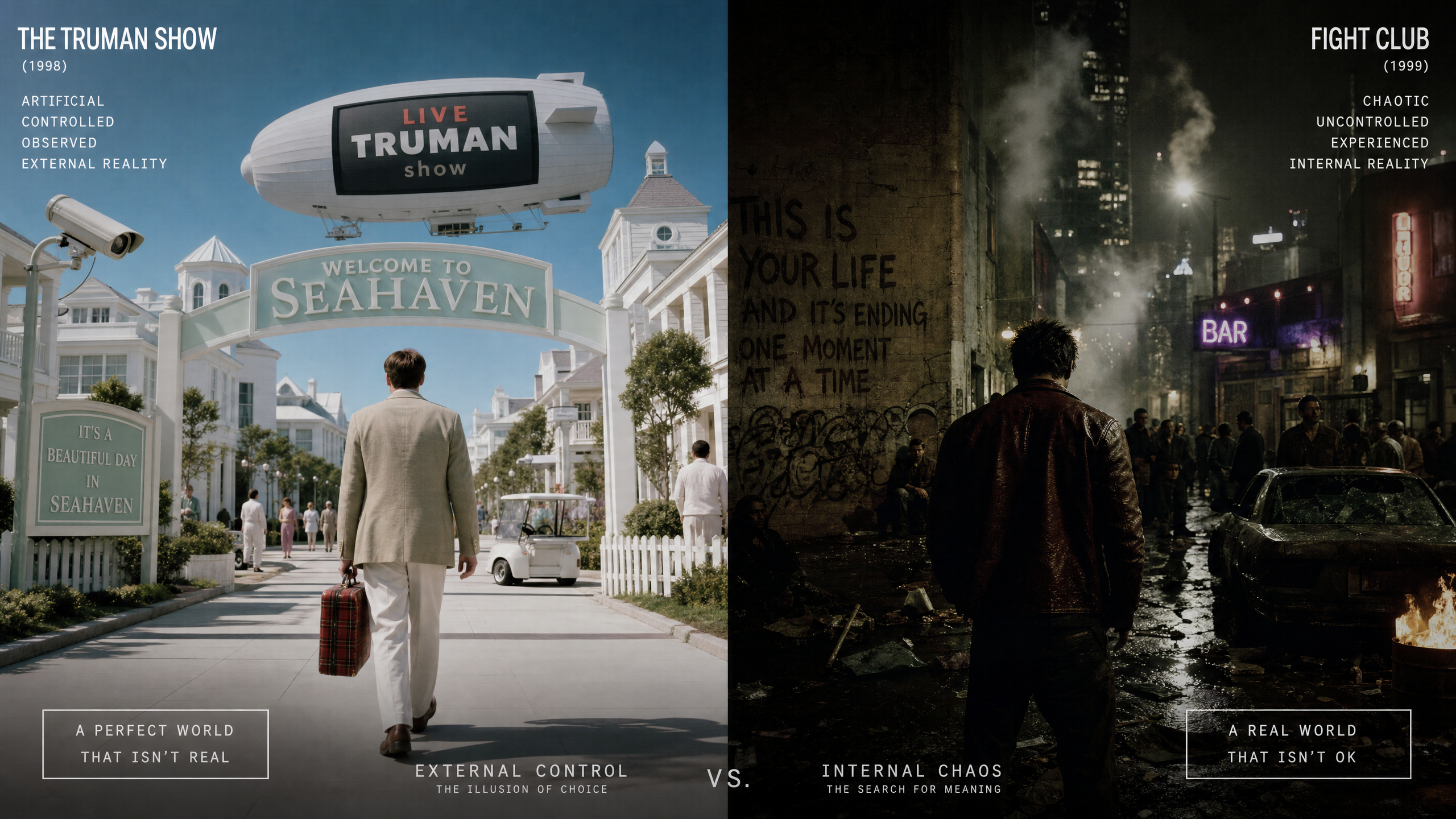
The Truman Show (1998)
In The Truman Show, reality is controlled by external systems. Truman lives inside a world designed by others.
The conspiracy is architectural. The walls are real walls. The sky is a painted ceiling. The friends are paid actors. The enemy is a producer in a control room — visible, namable, finite.
The escape, when it comes, is also architectural: a small door at the edge of the set, opening onto darkness.
- Reality
- External, designed
- Adversary
- The producer
- Tone
- Bright, pastel, observed
- Exit
- A door in the sky
Fight Club (1999)
In Fight Club, reality is unstable because of the mind. The main character creates another identity and cannot separate illusion from truth.
The conspiracy is psychological. The walls are inside his head. The friend is also him. The enemy and the rescuer share one face. There is no producer; there is only the unreliable narrator and his furniture.
The escape, when it comes, is interior: he must shoot the version of himself that has been writing the script.
- Reality
- Internal, fractured
- Adversary
- The self
- Tone
- Dim, gritty, ungoverned
- Exit
- A bullet, a window
Both texts reflect postmodern ideas. They show that truth is uncertain, identity is unstable, and reality cannot always be trusted. One film hands you the producer; the other hands you the mirror. Both end with the protagonist staring at something they had taken for granted.
“One man cannot trust the world. The other cannot trust himself. The audience leaves the cinema unsure of either.”
What unites them is suspicion. Not despair — suspicion. A refusal to accept that the well-lit, well-edited, well-narrated version of life is the only one available. After watching either film, the world looks slightly more like a set, and the self slightly more like a draft.